
Letters and sounds
34 lessons on Korean letters and sounds. This section is separate from the 43 chapters above.
34 lessons
Learn Korean with explanations in English
See how Korean sentences work with explanations in English. Build your understanding, then try it yourself.
Choose or change your learning language in the app.
가요.
Someone goes.
How a sentence becomes your own
아빠가 가요.
Dad goes.
Adds who goes.
아빠가 은행에 가요.
Dad goes to the bank.
Adds the destination.
아빠가 택시로 은행에 가요.
Dad goes to the bank by taxi.
Adds the transport.
내일 아빠가 택시로 은행에 가요.
Dad goes to the bank by taxi tomorrow.
Adds when.
5 levels · Words · Letters and sounds
43 chapters · 447 lessons + 34 on letters and sounds
Counts cover all prepared course materials. Check the app for the lessons available to you.
See what each level covers before you begin.
Say who does what, when, and why.
Describe actions and states in more detail; share what you heard and what you think.
Add conditions and guesses; tell apart what you experienced and what others said.
Distinguish reasons and results; state conditions and limits in writing.
Put nuance into concession, inference, warning and irony, and follow the flow of news articles.
Open a level to see its chapters and lesson counts.
34 lessons on Korean letters and sounds. This section is separate from the 43 chapters above.
34 lessons
Add a piece, then compare two sentences to see what changes.
가요.
Someone goes.
How a sentence becomes your own
Examples from a real lesson. This preview does not save progress.
가요.
Someone goes.
How a sentence becomes your own
아빠가 가요.
Dad goes.
Adds who goes.
아빠가 은행에 가요.
Dad goes to the bank.
Adds the destination.
아빠가 택시로 은행에 가요.
Dad goes to the bank by taxi.
Adds the transport.
내일 아빠가 택시로 은행에 가요.
Dad goes to the bank by taxi tomorrow.
Adds when.
산으로 가요.
Someone heads toward the mountain.
산에 가요.
Someone goes to the mountain.
으로 emphasizes a direction; 에 marks the destination.
Examples from a real lesson. This preview does not save progress.
Inside Tuh
Read a lesson, look through its notes, and keep going with practice and Review.
Open a level or chapter to see what you can learn.
Explore explanations alongside lesson examples.
Try more questions about a rule you have learned.
Come back to what was tricky.
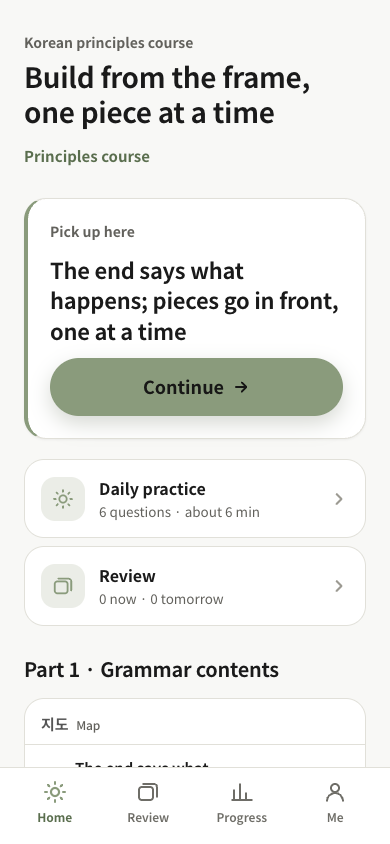
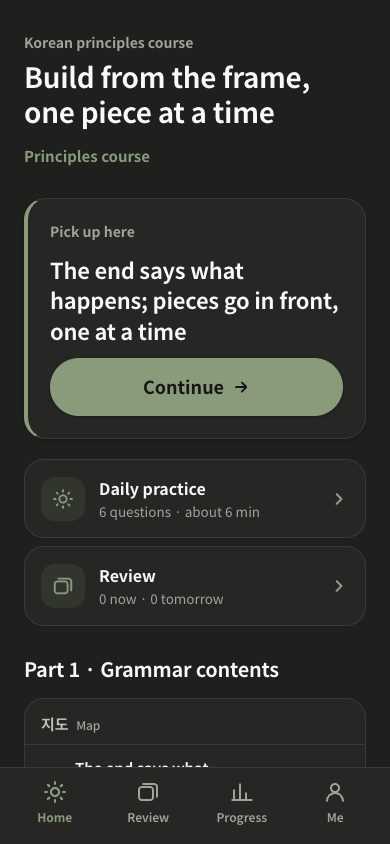
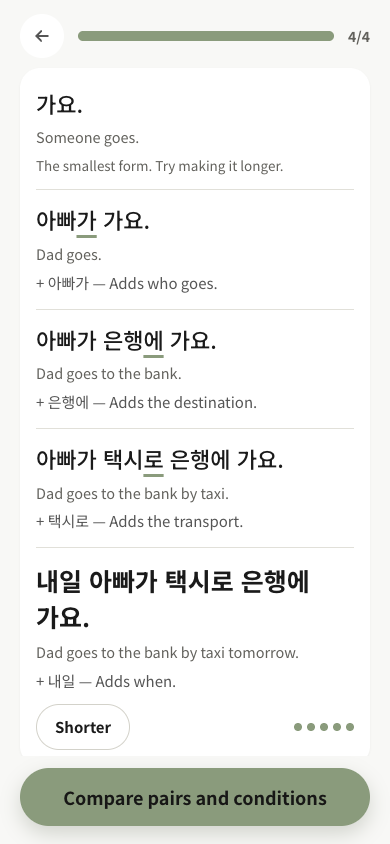
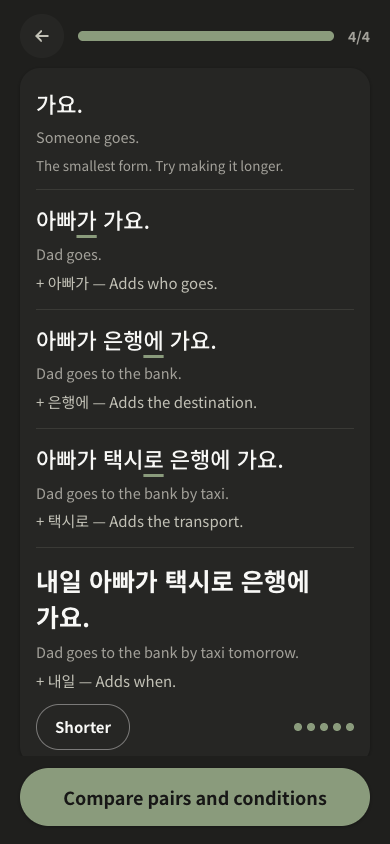
Earlier Korean course screens · explanations in English
Room to begin
Daily questions, review and the first two lessons in each course
Start freeAll lessons
Explore ProThis Korean course has explanations in English. A Turkish version is also available to explore.
The prepared course runs from Beginner 1 through Advanced 1, with separate Words and Letters and sounds sections. Explore the chapters above.
The first two lessons in each course are free. Continue with Pro to explore every lesson.
Yes. You can begin without signing up. Learning records are saved to the server only after you sign in and consent to saving them.
It starts with a sentence that makes sense.
No sign-up to start · No card needed
Choose or change your learning language in the app.